


What the CrushOn AI App Actually Does
Released for both web and mobile in 2024, the CrushOn AI app connects users with AI-powered virtual companions that can hold extended conversations, respond via voice, and generate images on request. The platform is built around a neural network that refines its responses over time based on your interaction history, which is the core mechanism behind its personalisation claims.
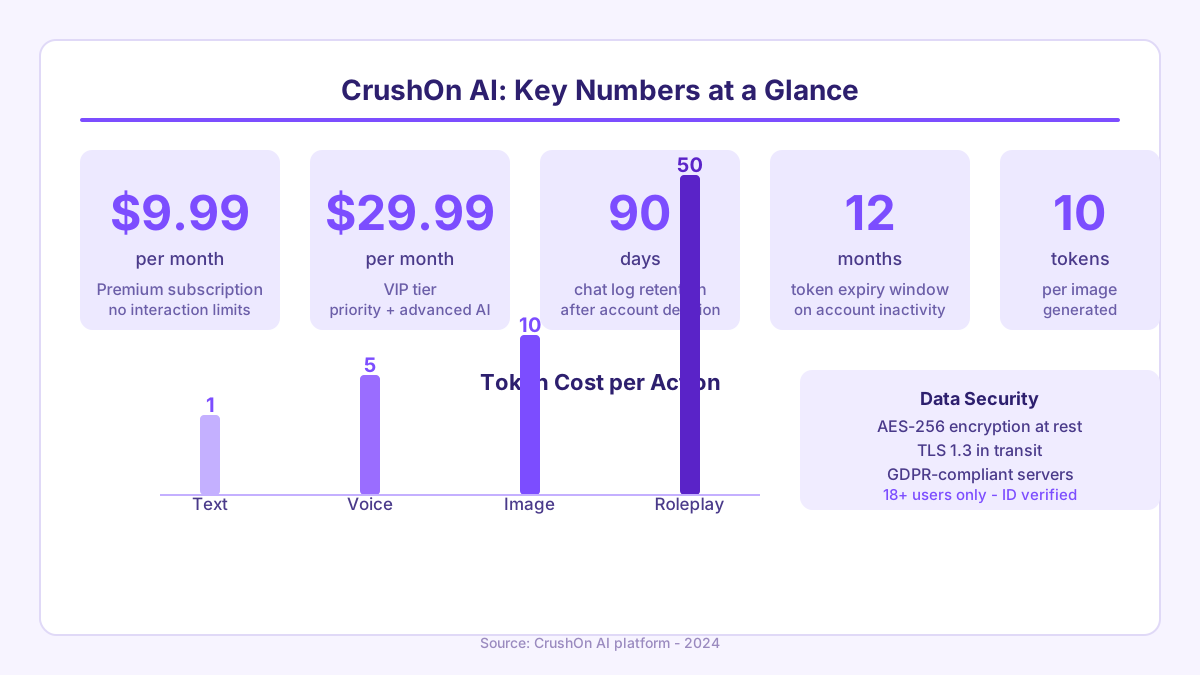
Three interaction layers sit inside the app. Text chat is the foundation, and it uses natural language processing to interpret tone, slang, and context rather than just keywords. Voice messaging adds a spoken dimension, though it draws on a separate token balance. Image generation is the third layer, letting users request visual content tied to their companion's appearance and setting. Each of these modes costs tokens at different rates, a pricing structure explained in more detail below.
The app is available through the CrushOn AI website and can also be found on major app distribution platforms. It is positioned squarely at adults seeking romantic or emotionally engaging AI interactions, and the platform makes clear in its own safety notices that the service is not a substitute for real relationships or professional mental health support.
How Pricing and Tokens Work
Understanding the cost structure before downloading saves confusion later. The platform runs on a freemium model with an optional subscription and a token economy layered on top. The free tier allows a limited number of interactions per day and includes occasional in-app advertising. The premium subscription is priced at $9.99 per month and removes interaction limits, enables voice features, and provides access to image generation. A VIP tier at $29.99 per month adds priority support, exclusive companion content, and access to the most advanced AI configurations.
Tokens power specific actions beyond standard chat. One token covers a single text message, five tokens cover a voice message, and ten tokens are required for each image generated. Special scenarios or customised roleplay prompts typically cost 50 tokens each. Token packs are sold separately: 100 tokens for $4.99, 500 tokens for $19.99, and 1,500 tokens for $49.99. One practical note worth flagging is that tokens expire after 12 months of account inactivity, so occasional users should keep that in mind when purchasing larger packs.
When I compared AI companion services a while back, one platform charged a one-time fee of 49.99 GBP while another used a subscription model similar to CrushOn AI. The subscription option improved noticeably over several weeks as the neural network updated and adjusted to my conversation patterns. The one-time purchase felt static by comparison. That experience shaped my view that ongoing subscription models often deliver better contextual understanding over time, even if the upfront cost looks higher.
Data Privacy and What Gets Stored
Data privacy is a legitimate concern for anyone using an AI companion app. The platform collects user profile information, chat logs, voice recordings, image prompts, and payment data routed through a third-party processor. All stored data is encrypted at rest using AES-256 and in transit using TLS 1.3. The servers used are described as GDPR-compliant, which matters for UK users post-Brexit given that UK GDPR aligns closely with the EU standard that took effect in 2018.
Chat logs are retained for 90 days after account deletion, not immediately wiped. Anonymised analytics may be kept indefinitely. Users can access, correct, or delete their data via account settings and opt out of marketing data processing. Third-party sharing only occurs with explicit consent for personalisation purposes, or in aggregated form shared with research partners. Transparency here is meaningful: the retention window of 90 days is a concrete detail that users should factor into any decision about what they share in conversation.
Age Verification and Content Filtering
The platform restricts access to users aged 18 and above. Verification is handled through a government-issued ID upload paired with a selfie for facial matching, processed by a third-party identity verification service. The ID data itself is deleted after verification passes; only the user's age and verification status are stored going forward. Re-verification is triggered every 12 months or when the system detects unusual activity.
Content filtering operates at two stages. Before a response is generated, the system scans prompts using keyword detection and semantic analysis. After generation, automated classifiers and human moderators review output. Prohibited content includes illegal activities, hate speech, non-consensual themes, and real-person impersonation. Users can report content directly in-app, and reports are reviewed within 24 hours. Violations result in warnings, temporary suspension, or a permanent ban depending on severity. This two-stage approach to filtering is a more robust safeguard than single-pass keyword blocking alone.
Known Limitations Worth Considering
No platform review is complete without naming real drawbacks. The token expiry policy is a practical frustration: unused tokens purchased in larger packs disappear after 12 months of inactivity, meaning cost-conscious users who buy the 1,500-token pack for $49.99 and then take a long break lose unspent tokens entirely. That is a material financial consideration, not a minor footnote.
A second limitation is that the AI companion, however well-tuned its neural network, does not carry genuine emotional awareness. The platform's own safety notices acknowledge this directly. Users who expect the AI to flag personal distress or escalate a crisis are advised to contact a qualified professional instead. The system is not equipped for that function, and treating it as a mental health resource would be a misuse of what the technology actually does.
Users looking for a creative storytelling companion rather than a romantic-only experience might also consider alternatives. Candy AI operates in a similar space and is worth comparing for feature breadth before committing to a subscription.
Comments
No comments yet.
Leave a comment
Your email will not be shown. Comments are reviewed before they appear.